

San Antonio’s missions are easy to admire from a distance. Stone walls, bell towers, carved facades and centuries-old churches make striking photographs. But if you leave with only the photographs, you have missed the most important part of the story.
The San Antonio Missions World Heritage Site is not simply a collection of old Spanish buildings. It is a cultural landscape shaped by colonization, faith, Indigenous labor and knowledge, adaptation, survival, agriculture, water, trade and generations of families whose connections to these places continue today.
That makes this week especially timely. San Antonio’s 11th annual World Heritage Festival runs September 9–13, 2026, with programming built around the missions and the communities connected to them. But the better reason to visit is larger than a festival calendar: these sites can change how we understand San Antonio when we stop treating the Alamo as the whole story.
Information and visitor details checked September 8, 2026.
Five missions, one World Heritage story
UNESCO’s San Antonio Missions World Heritage Site includes five 18th-century Spanish frontier mission complexes along the San Antonio River basin: Mission San Antonio de Valero—the Alamo—plus Mission Concepción, Mission San José, Mission San Juan and Mission Espada.
Four of the five—Concepción, San José, San Juan and Espada—make up San Antonio Missions National Historical Park. The Alamo is separately managed, but all five are part of the same UNESCO World Heritage property.
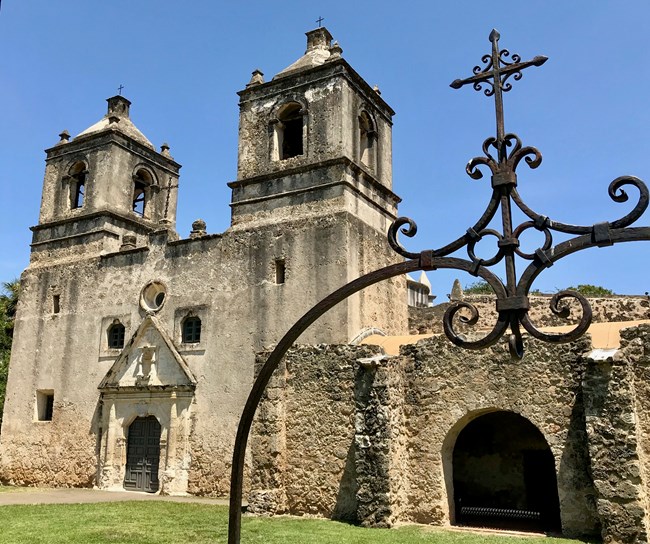
Mission Concepción, one of the four mission sites within San Antonio Missions National Historical Park. Photo: National Park Service.
UNESCO describes the property as a series of mission complexes containing not only churches but also residences, farmland, granaries, workshops, water systems and other structures. That distinction matters. A mission was not merely a church. It was a community and an instrument of the Spanish colonial frontier.
The history is meaningful because it is complicated
There is a temptation in heritage tourism to turn difficult history into something neat: Spanish architecture, Indigenous craftsmanship, beautiful churches, a successful cultural blend. The actual story is more complicated.
The missions were created as part of Spain’s effort to colonize, evangelize and defend the northern frontier of New Spain. Franciscan missionaries sought to convert Indigenous people to Christianity and draw them into Spanish political, economic and social systems. Indigenous South Texans supplied much of the labor that built and sustained the mission communities.
Those facts should not be softened into a purely romantic story. But neither should Indigenous people be presented only as passive victims who disappeared when the mission era ended.
National Park Service interpretation at Mission San José notes that many South Texas and northern Mexico families—and many mission descendants—trace Indigenous roots to Coahuiltecan groups connected to these communities. The park describes the stone structures and irrigation systems as part of a living cultural heritage built by Indigenous mission residents, and descendant families continue to maintain connections to these places.
What UNESCO means by an interweaving of cultures
One reason the missions received World Heritage recognition is the visible interaction between Spanish and Indigenous cultures. UNESCO points to architecture, settlement patterns, water distribution, agriculture and decorative elements that combine Catholic imagery with nature-inspired Indigenous designs.

The Rose Window at Mission San José, one of the site’s best-known examples of Spanish Colonial ornamentation. Photo: National Park Service.
You can see that story in stone, but also in systems that are easier to overlook. The missions depended on irrigation, agriculture and ranching. The San Antonio River and the network of acequias—irrigation channels—helped sustain the communities. Roads such as El Camino Real de los Tejas linked San Antonio to other parts of New Spain, moving goods, people and information.
Seen this way, the missions become less like isolated monuments and more like pieces of a regional network.
The heritage is still living
One of the strongest reasons to visit now is that interpretation increasingly includes people whose families and communities remain connected to the missions.
The 2026 World Heritage Festival includes programming with the San Antonio Mission Indian Descendants at Mission San José on September 11, designed around the culture, community and living heritage of Indigenous families connected to the missions. A September 12 program with the Tehuan Band of Mission Indians of San Antonio combines an indoor presentation and outdoor ceremony. At the Alamo, Mission Day on September 12 is scheduled to include descendants of Indigenous mission residents as well as descendants of Canary Island and other founding families.
That is a useful model for heritage travel: whenever possible, listen not only to institutions interpreting a place, but also to descendant communities interpreting their own connections to it.
How to visit the missions without turning the day into a checklist
You can technically move quickly from site to site. That does not mean you should.
Start at Mission San José. It is the largest of the mission sites and the location of the National Park Service visitor center. NPS recommends beginning there with the museum and free park film; free ranger-led walks also begin there. San José gives you enough context to make the other missions more meaningful.
Add one or two missions rather than rushing all five. Mission Concepción, San Juan and Espada each have their own character. If your goal is understanding rather than collecting photographs, fewer sites with more time at each usually produces a better day.
Remember that the four mission churches inside the national historical park remain active Catholic parishes. These are heritage sites and places of worship at the same time. Services, ceremonies and local community life are not tourist performances. Enter respectfully, follow posted guidance and avoid disrupting worship.
Look beyond the church buildings. Seek out the granary, grist mill, irrigation features, family quarters, agricultural landscape and interpretive material. Those elements help explain how mission communities actually functioned.
Use the Mission Reach when it fits your pace. NPS notes that visitors can drive between the missions or walk and bike portions of the paved Mission Reach Hike and Bike Trail connecting the sites. Choose the method that matches your mobility, weather conditions and available time rather than treating the route as an endurance test.
A practical half-day plan for a slower traveler
For travelers who prefer depth over rushing, a strong half-day can be simple:
- Begin at Mission San José: visitor center, film and ranger interpretation.
- Walk the grounds slowly: church exterior, family quarters, granary, mill and irrigation story.
- Choose one second mission: Concepción for another major architectural complex, or San Juan/Espada for a quieter look at the southern mission landscape.
- Leave buffer time: historic surfaces can be uneven, and NPS cautions that these centuries-old structures were not built to modern safety standards.
- Check current conditions: operating hours, ranger programs, church activities, weather and festival schedules can change.
This is the same principle behind good travel pacing generally: seeing less can help you understand more.
World Heritage Festival 2026: a timely doorway into the story
The City of San Antonio World Heritage Office says the 11th annual festival runs September 9 through September 13, 2026. Programming spans educational events, descendant-community presentations, heritage tours, the Tour de las Misiones cycling/walking events and other activities associated with the World Heritage site.
If you are in San Antonio during the festival, use the schedule as a way to deepen a trip—not as a requirement to chase every event. The most valuable programs may be the ones that place local and descendant voices at the center.
Because event times, capacity and registration can change, verify details on the official World Heritage Festival site before traveling.
Why this belongs on a travel itinerary
San Antonio is often marketed through food, the River Walk and the Alamo. All three can be worthwhile. But the mission corridor reveals a broader city: one shaped by Indigenous communities, Spanish colonial expansion, Mexican and Texan history, Catholic traditions, agriculture, water engineering and families whose heritage does not fit inside one famous battle.
That is what meaningful heritage travel can do. It does not ask us to admire less. It asks us to notice more.
The stonework is beautiful. The deeper story is the people.
Plan with official sources
Before visiting, check the National Park Service San Antonio Missions National Historical Park site for current hours, programs, accessibility and alerts, and the official World Heritage Festival schedule for 2026 events.
For more Retired Traveler heritage coverage, read National Parks Are More Than Scenery. If you want to build a comfortable multi-stop day, pair this with Travel Pacing for Retirees.
Primary sources checked September 8, 2026: UNESCO World Heritage Centre; U.S. National Park Service, San Antonio Missions National Historical Park; City of San Antonio World Heritage Office / World Heritage Festival. NPS photographs used here are credited to the National Park Service; NPS states that images credited to NPS without a copyright symbol are public domain.